Thick Rubber Plates
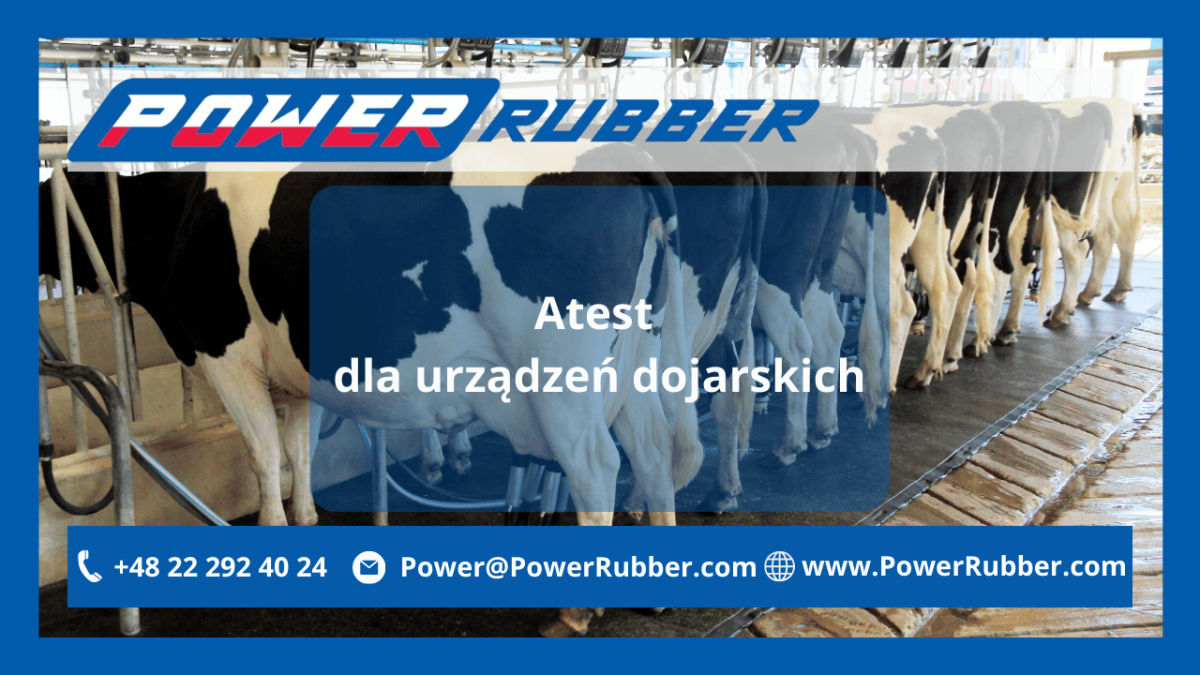
Every newly introduced device intended to work in contact with food should have an appropriate certificate. To enable the use of a milking device, it is worth considering the purchase of a product with a certificate. According to the recommendations of the European Union, devices that have direct contact with food should be certified at least once a year.
In Poland, certificates for devices are handled by the National Institute of Public Health – State Hygiene Institute (PZH). This institution, founded in 1918 under the name State Central Institute of Epidemiology and renamed PZH on September 7, 1923, deals, among other things, with hygiene issues and also conducts service-research and scientific work. After 2002, the Act on the conformity assessment system (Journal of Laws 2002 No. 166, item 1360) states that applying for certifications is voluntary. However, the obligation is not removed from materials and products that come into contact with water intended for human consumption, as specified by the Regulation of the Minister of Health on the quality of water intended for human consumption of December 7, 2017 (item 2294). Thus, the State Hygiene Institute issues certificates confirming a product's suitability for operation in conditions where machinery comes into contact with food. Most often the certificate is obtained by silicone products.
Animal safety and certification
An excessively large number of somatic cells per unit volume of milk, as well as diseases of teats and udders, is a common problem associated with the improper operation of milking devices. Proper operation of the machine is an extremely important element both in terms of safety and work hygiene, but also in caring for animal welfare.
Parameters of milking devices, such as the vacuum level in the lines, pressure fluctuations under the teat, duration of the suction cycle, duration of the massage cycle, diameter of the discharge pipes, and diameter of the collector outlets should be well known to the person operating and daily assessing the milking machine's performance. This will ensure more conscious use, and a weekly routine check of the technical condition of the device will allow its safe use and obtaining high quality of the produced product.
Checking the PZH Certificate
According to current law in Poland, every manufacturer, as well as persons responsible for introducing a certified product to the market, have the right to copy, photograph, and distribute the certification document in digitized form for marketing or informational purposes. According to this assumption, every product that has received a certificate should make it publicly available without major difficulties so that the customer can review the certificate before purchase.
It is also worth remembering the graphic mark that is issued with the certificate and that the manufacturer may place on the device. On the device, it is worth looking for a navy-and-white circle with a tree graphic and the abbreviated name of the issuing institution, i.e., the State Hygiene Institute (PZH). Such a mark gives us certainty that the product has the certificate of the National Institute of Public Health.
Choosing a device with certification
When choosing a milking device, you should remember a few important facts. Devices that have a certificate are the best choice when work with animals or humans is involved. Certified devices prevent exposing oneself to serious consequences resulting from unknowingly causing a hazard to people or animals, or harm to health or illness. They also help maintain the highest quality of the milk produced.
The device manufacturer becomes responsible for the product's safety, which is a very important factor from the point of view of the consumer and the user of the machine, indicating the correctness of purchasing a certified device. An indispensable aspect is also the participation of the milk supplier in tenders or supplier selection processes.
Having certified devices may sometimes be a requirement of the company announcing the tender, and in another case it may also be the deciding factor in choosing a supplier over others who do not have such a certificate, thanks to obtaining the highest rating. Having certified devices may result in expanding the farm's business to cooperate with new companies.
Certificate for devices in use
Due to the frequency of use of milking devices (twice a day, or even more often), in order to prevent unforeseen failures, it is worth adopting the practice of making a visual inspection of the milking installation before each milking session. Such routine activities will help avoid unnecessary interruptions and malfunctions during system operation.
Equally important is the selection of sealing elements that come into contact with milk. More information about such solutions can be found in the article about rubber gaskets for food contact.
Additionally, these simple procedures will reduce the probability of diseases and inflammatory conditions of the mammary gland in animals, and will also ensure the farm owner the highest quality of the milk they obtain. Furthermore, once a year it is worth commissioning an inspection of the milking system by a qualified employee whose authorizations allow for maintenance work and the issuance of certificates for milking devices.
The cost of the technical inspection depends on the size of the milking machine and its type, and is not fixed. The expense you should be prepared for ranges between 100–200 PLN. The inspection consists of checking the general condition of the device; the vacuum gauge readings, that is the instrument responsible for measuring pressure, are subjected to more detailed examination. The person performing the maintenance will likely also look at the performance of the vacuum pump, check for leaks in the milk pipeline system as well as the air system.
The specialized tools possessed by a qualified employee of a company dealing with certifications will allow for precise adjustments that the device used on the farm may require.
When assessing the technical condition of the installation, it is also worth paying attention to the hoses transporting milk. More information about their requirements and selection can be found in the article about certified rubber hoses for milking machines.
Certification and sanitary inspections
A certificate confirming that the product complies with applicable standards is also an element of sanitary inspection. Veterinary inspectors pay attention to the fact that milking equipment should have a so-called declaration of conformity. Having such a declaration indicates that the milking equipment we use, which has direct contact with raw product, was made of materials that prevent contaminants in the form of toxic substances from entering the milk.
Possessing a declaration of conformity is also a guarantee that the product purchased by the user is approved for contact with food. Therefore, if the certificate is not available, this may result in a fine being imposed on the owner of a non-certified machine. It is worth mentioning that the declaration of conformity is a document that the farm owner is obliged to present during an inspection by a veterinary inspector.
For professional advice, please contact us by phone at +48 22 292 40 24 or +48 505 16 03 03, or by email (Power|PowerRubber.com| style="background-color: rgb(255, 255, 255); color: rgb(0, 91, 171); border-bottom: 1px dotted rgb(0, 91, 171); text-align: justify;"|Power|PowerRubber.com) or via our contact form.