Flooring in the garage
A garage is a place for storing a car, tools and equipment. However, nothing prevents you from turning this room into a safe and efficient workshop without the need to break up the floor and remove debris. The garage floor should look nice, be easy to clean and be functional. The key to achieving a durable finish in the garage is proper preparation of the floor.
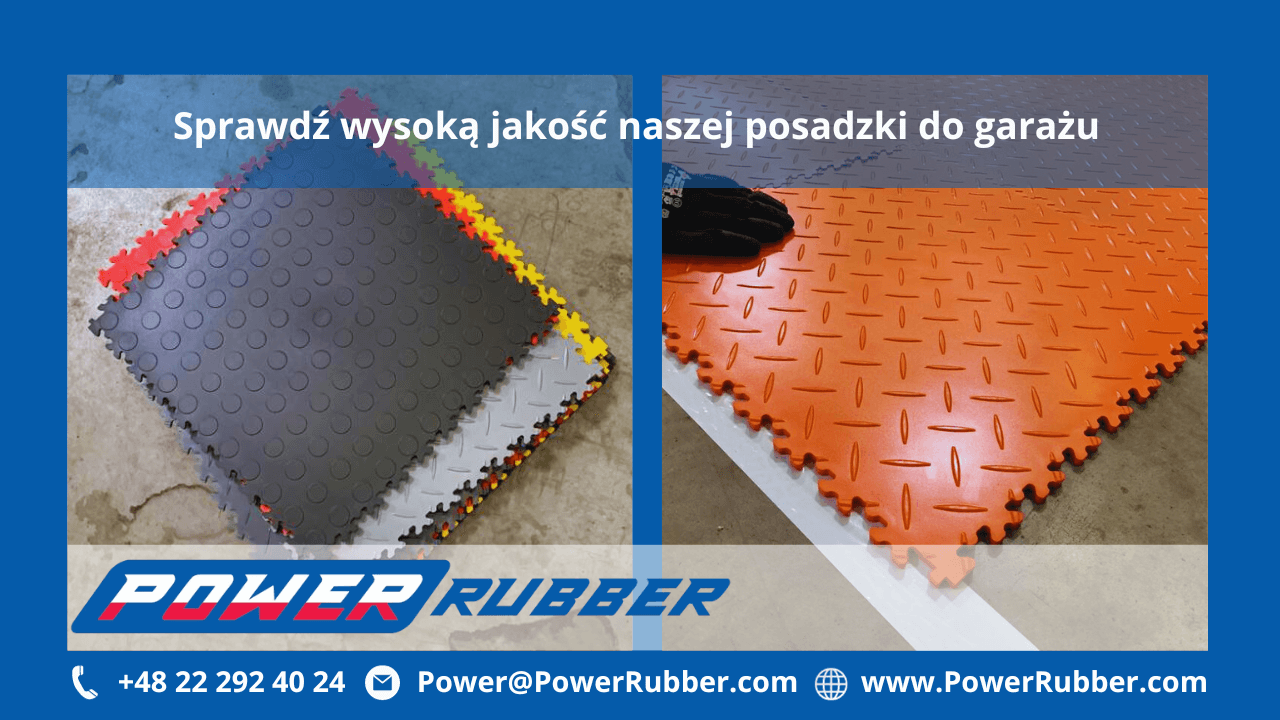
See what PowerFloor PRO PVC tiles look like at their highest standard.
Garage floor - which to choose? Which flooring materials are best?
The garage floor is usually subjected to heavy loads from a parked car or other large vehicles. There are many types of flooring available on the market that can be used in a garage: resin flooring, concrete flooring, epoxy flooring, ceramic tiles, porcelain tiles, PVC floors.
Epoxy flooring
Installing epoxy flooring in a garage protects the floor from dirt, moisture and chemicals. An epoxy resin floor is slippery, especially when wet or if oil is spilled. An anti-slip additive — quartz sand — can be added to the coating. Adding particles of quartz aggregate to a resin floor creates an anti-slip surface, making it safer to use.
It is worth noting that resin flooring is not suitable for rooms with moisture problems (e.g. basements). The floor must be dry and prepared; otherwise, the epoxy resin may detach from the surface.
Resin compounds are laid in layers with a thickness of 1 to 6 mm. It is possible to install resin flooring yourself, but it requires knowledge and experience. Curing the resin is time-consuming and can take up to 6 weeks.
Concrete flooring
A reinforced concrete screed should have a minimum thickness of 5 to 15 cm. The concrete floor must not only have a specified thickness of 5–15 cm, but also be formed with a slope of 2–3% toward a drain grate or drainage channel, which protects against flooding during heavy rainfall.
A concrete screed absorbs oil spilled on it, and resulting stains can be difficult to remove. To reduce the absorbency of raw concrete, it can be additionally impregnated. It is enough to apply the preparation with a brush or roller directly onto the concrete. An impregnated concrete floor in the garage is easy to clean. The impregnation treatment should be repeated regularly.
The garage floor can also be made from cementitious screed (e.g. using a ready-mix dry blend) or self-leveling compound. The floor can also be finished with ceramic tiles (e.g. porcelain tiles), which are available in various textures and colors.
At Power Rubber, however, we recommend a garage floor made of PVC, which you can read about in the rest of the article — welcome!
PVC garage flooring - Advantages and properties
PVC tile floors work excellently in garages. They have many exceptional properties, here they are: Durability and longevity
PVC flooring is resistant to mechanical damage. The tiles are designed to withstand pressure caused by furniture, equipment, tools, and even the significant weight of a vehicle. This type of garage flooring is extremely durable — it withstands harsh conditions, including snow and rain. The material is characterized by resistance to abrasion and compression, as well as loads and vibrations. A garage surface made of thermoplastic PVC retains its performance throughout its service life. It also provides proper thermal insulation thanks to specially designed locking elements that prevent heat loss.
Traction
When deciding to replace the floor in a garage, we must remember to ensure that it provides adequate traction. A garage floor made of thermoplastic PVC is available in various textures that provide anti-slip properties.
Resistance
PVC flooring is waterproof, minimizing the risk of mold growth. It is highly resistant to oil, petrol, most solvents and solutions, so the substances used will not damage the floor. A garage floor must be resistant not only to abrasion but also to most corrosive factors, which significantly affects its durability.
Wide range of textures and colors
In the Power Rubber shop we offer a wide range of PVC tiles available in a broad variety of colors and textures, allowing you to match the right shade to any room.
Easy installation and replacement
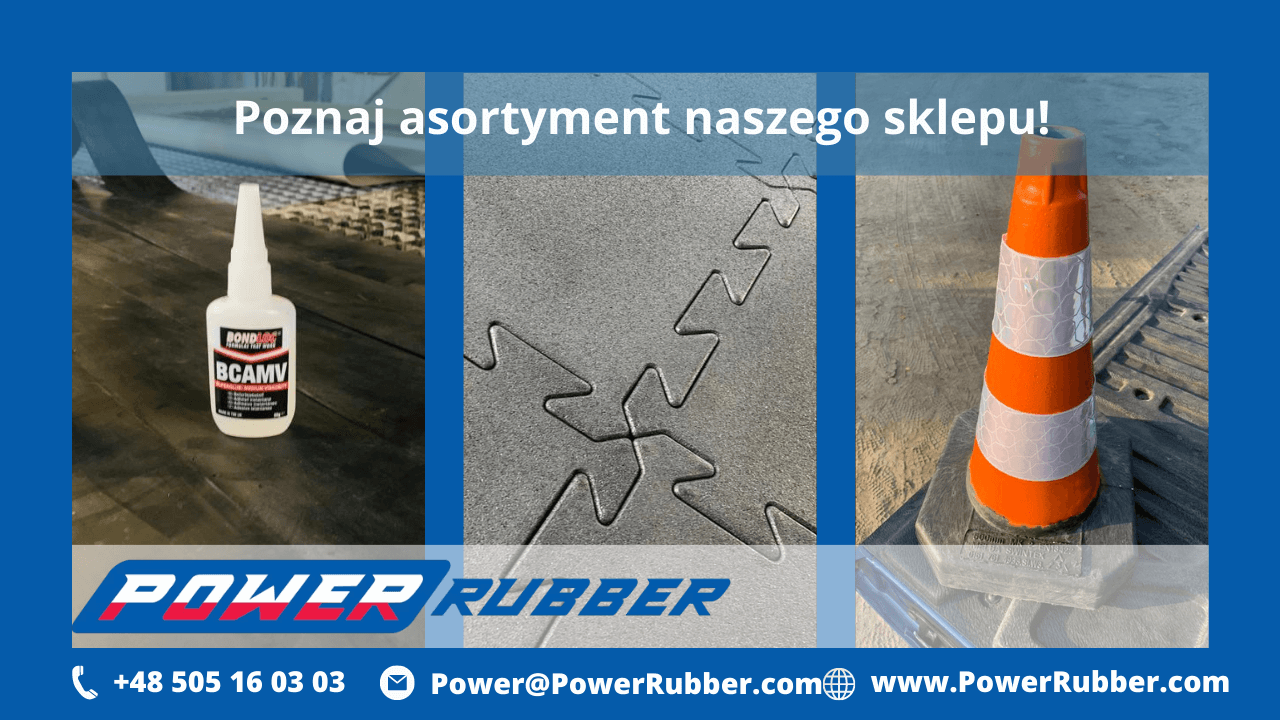
The garage floor should be easy and trouble-free to install. Our offered tiles have interlocking patterns, allowing them to be connected to each other. Fortelock locks are a solution that eliminates the need to glue the tiles to the substrate. If a single tile is damaged, it can be replaced without having to dismantle the entire surface.
A major advantage of PVC garage flooring is that it does not crack like, for example, ceramic tiles, does not require grouting or the use of any self-leveling compound, does not need to be painted (or the wall strip just above the floor), impregnated, spread with a roller (as with resin compounds), or have cement laitance removed before installation, etc.
PVC tile flooring can be laid dry over an existing floor in the garage (e.g. over a primed substrate). They can be installed at any temperature.
Easy to maintain
Dirt and contaminants can be removed with a broom, vacuum cleaner or a damp mop. As mentioned earlier, if damaged, the locking system facilitates the replacement of individual tiles.
Check how quickly and effectively you can install a new garage floor:
Stage I – planning
Sketch the dimensions of the room in any graphics program or on paper. Draw a top view of the room and provide the exact floor dimensions.
Send us the room sketch along with information about your choice of tile color to: power|powerrubber.com| |power|powerrubber.com
Stage II – preparing the garage and laying the tiles
Tidy the garage floor
The first step is to clear the garage floor of all items located on it. If you are moving equipment or tools outside, it is worth covering them with a tarp in case of rain. Thoroughly clean the entire surface of dirt and contaminants by vacuuming or carefully sweeping it (remember to clean the corners thoroughly).
Preparing the garage or boiler room floor
If the current surface in the garage is concrete or a floor screed (cement screed/finish) — the substrate should be covered with a primer.
If there are tiles, PVC flooring, or old paint or epoxy resin on the floor — such a floor does not require reinforcement of the substrate (priming).
Use a fast-drying filler if you notice visible, large defects in the substrate.
Laying the tiles
-
It is important to first mark the axis of the room from the garage door to the wall that is parallel to it.
-
Begin laying the tiles from the garage door along the marked room axis and from the axis to the exterior walls.
-
ATTENTION! The tiles are secured with Fortelock locks. Therefore, no gluing is required. Remember to use a rubber mallet when connecting tiles together. Always start connecting from the corner of the tile along the lock.
-
After completing the installation of the tiles on the substrate, finish the floor by laying cut pieces at walls and partitions. Measure the missing piece precisely with a ruler and cut the tile using a knife, a jigsaw with a brushless motor, or a circular saw for plastics. Maintain a perimeter expansion gap, i.e. a 4–5 mm gap between the tile and the building wall.
-
The junction of the floor and wall can be finished by creating skirtings 5–10 cm high. Use polyurethane adhesive (PU) for this task.
-
IMPORTANT! When installing this type of floor in a garage, you should use polyurethane adhesive to glue down the first row of tiles that are installed along the garage door threshold. This is important in case you drive into the garage up a ramp.
Put the tools and equipment back into the garage and you're done!
Tiles in a single-car garage of standard dimensions 3×5 m can be laid by two people in less than an hour.
Such a garage floor is characterized, among other things, by long service life and low maintenance cost. At any time it can be quickly dismantled and installed in a new location.

High-quality garage flooring available at the Power Rubber store
PVC floors, preferably from a trusted manufacturer that uses the best materials in their production, work best in a garage. At Power Rubber we offer thermoplastic tiles made from top-quality PVC that are suitable for the garage, boiler room, basement, gym, and also for an automotive workshop.
Features and advantages of our garage flooring:
- provides thermal insulation
- available in a wide range of patterns and colors
- excellent stability and traction
- reliable snap-fit system allows for quick and easy installation
- high resistance to wear and mechanical damage (the material is resistant to, among other things, abrasion and compression)
- PVC garage flooring is easy to maintain and clean (does not require special agents, does not need impregnation)
- waterproof and frost-resistant
- chemically resistant
- anti-slip structure
- PVC floor tiles do not require leveling of the surface in the case of minor irregularities
-
floor finishing - the client does not have to wonder "how to finish the floor" or "whether it is worth impregnating the floor" - this type of floor does not require paints or impregnations for protection - the client receives a ready product
-
offered floor thickness: 8 mm
-
they can be easily moved to other locations
-
environmentally friendly (suitable for recycling)
-
economical repairs - individual tiles can be replaced if necessary
If you are looking for a reliable garage floor that will withstand the heavy load of a car without risking damage and destruction, please contact us by phone: +48 22 292 40 24 or +48 50 516 03 03, by email (power|powerrubber.com| style="background-color: rgb(255, 255, 255); color: rgb(0, 91, 171); border-bottom: 1px dotted rgb(0, 91, 171); text-align: justify;"|Power|PowerRubber.com) or through our contact form