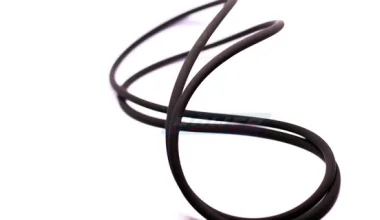
Vacuum Seal Rings
A vacuum and high-temperature environment requires the selection of an appropriate sealing ring that must guarantee high performance without the risk of cracking.
Sealing rings for vacuum applications - Material
Key factors to consider when choosing a material for sealing rings intended for vacuum applications are:
Permeability
Permeability, i.e. gas permeation, varies, among other things, depending on the type of selected material, hardness, pressure, temperature, and the type of gas. Due to its lower permeability, the most popular material from which O-rings for vacuum are made is FKM / Viton® A. Other materials suitable for use in a vacuum environment include, among others: Buna-N (NBR), EPDM, fluorosilicone (VFMQ), Viton GF, PTFE, polyamide, silicone, FFKM / Karlez®. Importantly, gas permeability should not be confused with leakage.
Compression set
O-rings used in a vacuum environment should tend to return to their original state after compression is removed. If an O-ring is unable to return to its original state after compressive stresses are removed, this results in reduced sealing force, and consequently - decreased tightness, which increases the risk of leakage.
Outgassing
Additional solvents and plasticizers with low vapor pressure that are part of the elastomer may evaporate under high vacuum conditions. Materials developed from pure polymers and without volatile components provide low outgassing. Materials outgas in three ways: desorption from the bulk material, desorption from the surface, and evaporation.
Operating temperature
O-rings used for vacuum environments should be made from rubber compounds that feature maximum thermal resistance. Temperature plays an important role in the performance and durability of sealing rings. An O-ring, depending on the material from which it was produced, has its own temperature range in which it can operate effectively. Elevated temperatures can cause seal degradation, swelling or outgassing. Thermal degradation is often accompanied by compression set.
Surface contamination
Temperature, humidity, lubricants, curing—these are just some of the factors that can affect the quality of the surface of a finished, manufactured O-ring. For an O-ring to function correctly it must be free of contaminants, cracks, scratches, and must also have a circular cross-section.
Chemical compatibility
Choosing a material that is compatible with the chemicals and operating temperature to which it will be exposed minimizes the risk of costly failures. The chemical compatibility of seals should be tailored to the specific application. The higher the concentration of chemicals, the more caution should be exercised when selecting O-rings.

O-rings in vacuum - Properties
O-rings are seals most commonly used for vacuum applications. They prevent air from the surroundings from entering the vacuum. They are made from various rubber compounds with different hardnesses from 65 to 80 ShA (pay attention to the markings). An advantage of these O-rings is their ability to adapt to minor irregularities of the mating surfaces. Sealing rings of the O-ring type for vacuum applications have lower hardness to provide a larger contact area and consequently - lower conductance. Material selection is based on its thermal compatibility.
Here are the desired characteristics that O-rings used in vacuum environments should have:
-
excellent resistance to gas permeation
-
good resistance to moisture
-
low vapor pressure at operating temperature
-
must not contain any elements or materials that evaporate under the pressure and temperature to which the joint will be exposed
-
resistance to high temperatures
The place of application of O-rings depends largely on the type of material, hardness, thermal and chemical compatibility. O-rings are used in static joints in hydraulic and pneumatic devices, as well as in dynamic applications in connections of machine and device parts.
O-rings - Properties of selected materials
FKM / FPM / Viton O-rings
Viton O-rings are characterized by resistance to mineral oils and silicone greases, silicone oils, animal fats, vegetable oils, fuel, and gasoline. Additionally, O-rings made from Viton material have a flexible structure, making them resistant to non-flammable hydraulic fluids of the HFD type, as well as propane, butane, diluted acids and bases. This type of fluorinated O-ring exhibits excellent resistance to aromatic and chlorinated hydrocarbons, aliphatic hydrocarbons, glycol-based brake fluids, concentrated sodium hydroxide solutions, ketones and esters. It is one of the most important elastomers developed in recent times. FPM / FKM O-rings perform well in many industries, both in stationary and moving machine and device parts.
O-rings in an FEP / PFA jacket
Seamless jacketed O-rings consist of an elastomeric core (silicone rubber or Viton) and an FEP / PFA coating. A seal made from these materials provides excellent tightness and high chemical resistance in any application. The FEP and PFA copolymer is a high-quality thermoplastic characterized by limited gas permeability. This type of O-ring has a low coefficient of friction and operates over a wide temperature range (the temperature range reaches from -60° C to +260° C for a silicone core in a PFA jacket). Due to their properties, they are suitable for static seals, for example in the automotive, oil, chemical, and petrochemical industries.
NBR O-rings
NBR O-rings are characterized by low permeability and the ability to return to their original shape after stress (no permanent deformations). The elastomer exhibits high tensile and abrasion resistance. It copes effectively in contact with fats, greases, oils, as well as chemical compounds. The material is commonly used for removable vacuum seals.
EPDM O-rings
EPDM O-rings have the ability to undergo reversible deformation as a result of mechanical forces. The material is resistant to atmospheric conditions, organic and inorganic acids, bases (potassium and sodium as well as cleaning agents), polar solvents, phosphate-ester hydraulic fluids, silicone-based oils and greases. This type of elastomer is used in many industries. It operates in an operating temperature range from -40°C to +110°C (some even up to +150°C).
Silicone
Silicone VMQ O-rings are also called high-temperature O-rings - they operate in the temperature range from -50°C to +300°C. They have very good sealing properties as well as the highly desirable durability and strength. This type of round-section sealing ring does not degrade as a result of long-term exposure to UV radiation. Effective in contact with mineral greases, oxygen, and salt solutions. It exhibits low outgassing. Due to high flexibility and abrasion resistance, it is suitable for use in vacuum conditions.

FFKM / Kalrez® O-rings - excellent chemical resistance
O-rings are made from perfluoroelastomer rubber, which is characterized by increased resistance to aging in atmospheric conditions, and the effects of oxygen and ozone. FFKM O-rings are distinguished by chemical resistance (including to inorganic acids), as well as resistance to high temperatures (periodically even up to +350°C). This elastomer is little prone to swelling. It is characterized by durability and low permeability, as well as high mechanical properties.
The material exhibits high resistance to oils and greases, alcohols, gasoline, diesel, and silicone oils. It is one of the most resistant materials to aging when in contact with hot air. It features a low permeation coefficient and thus little tendency to swell. Moreover, among various types of compounds, Kalrez® demonstrates self-extinguishing and non-flammable properties when in contact with air. Its operating temperature ranges from -46 °C to + 325 °C.
O-rings are intended for the most demanding applications, both in static and dynamic applications. They are suitable for use in a vacuum environment.
At the Power Rubber store we offer a wide range of O-rings that allow adaptation to a specific application.
Call us or send an inquiry.
Contact us by phone at: +48 22 292 40 24 or +48 50 516 03 03, or by email (power|powerrubber.com| |Power|PowerRubber.com) or via our contact form