Regulation (EC) No 1935/2004 on Materials and Articles Intended to Come into Contact with Food
During processing, manufacturing and storage, food comes into contact with many materials and articles that can be a source of contamination. To reduce the risk of food contamination, regulations have been established concerning the safety of 17 groups of materials in contact with food during its production, storage, preparation or serving.
The European Commission, in order to harmonize the rules concerning materials intended to come into contact with food, established Regulation (EC) No 1935/2004 in 2004. It sets out the main requirements for materials and articles intended to come into contact with food, as well as requirements for labeling and traceability, and the procedure for authorizing substances by the European Food Safety Authority.
Purpose of Regulation No 1935/2004 on materials and articles intended to come into contact with food
Regulation (EC) No 1935/2004 of the European Parliament and of the Council of 27 October 2004 on materials and articles intended to come into direct or indirect contact with food aims to:
- establish uniform rules concerning contact materials and articles (FCM), such as food processing machinery, food transport containers, tableware, bottles, which may have indirect or direct contact with food;
- ensure a high level of protection of human health;
-
facilitate the free movement of goods, services and capital anywhere in the European Economic Area;
Regulation EC 1935/2004 concerns contamination resulting from migration of chemical substances from a material in contact with food and mixing with it. The provisions allow the use of active and intelligent materials that may extend the shelf life of food, provided that this does not affect its composition.
Four categories of contact materials (FCM) are subject to additional, detailed rules:
- monomers and additives for plastics (governed by Regulation (EU) 10/2011)
- intelligent and active materials and articles (AIM) (governed by Regulation No 450/2009)
- plastic materials from recycling (governed by Regulation No 282/2008)
- regenerated cellulose film (RCF)
Requirements for contact materials (FCM) and articles intended to come into contact with food specified in Article 3 of Regulation No 1935/2004
Requirement No. 1
Materials or articles intended to come into contact with food (FCM) should be manufactured in accordance with good manufacturing practice (GMP), so that under normal conditions of use:
-
they do not release constituents into food in quantities that could represent a danger to human health;
-
they do not cause a change in the odor or taste of the food;
-
they do not cause unacceptable changes in the composition of the food or deterioration of its organoleptic properties;
Requirement No. 2
Labeling, advertising and the manner of presenting individual groups of materials and articles should not mislead consumers. Information should be visible, legible and indelible.
-
materials used for packaging must be marked as "for food contact" and bear the appropriate logo;
-
labeling rules should include indication of intended use (e.g. tablespoon) or the addition of a symbol (cup and fork);
The requirements apply to materials and articles intended for direct and indirect contact. The provisions do not apply to antique materials, articles and coatings (e.g. cheese rind).
Benefits of introducing Regulation No 1935/2004
Regulation EC 1935/2004 contains provisions concerning general use for 17 groups of materials, such as: plastics, metals, adhesives, ceramics, rubber, wood.
Food safety
-
under normal or foreseeable conditions, no migration of material constituents into food occurs
-
studies determine the migration of toxic substances into food (the regulations establish allowable limits for material intended to come into contact with food)
-
guarantee of food and nutrition safety
-
materials and articles do not cause harmful effects to human health, do not change the composition of food and do not introduce unwanted taste and odor into it
-
information about the condition of food, e.g. hiding signs of food spoilage
Clear labeling
- products properly labeled
- clear information "for food contact" or the use of an equivalent symbol
-
special recommendations to be followed for safe and proper use
- marking or identification labels
Full traceability of materials
-
appropriate marking or identification labels ensuring the possibility of tracing the path of materials or articles by labeling or appropriate documentation (possible identification of companies supplying and receiving materials)
- possibility of withdrawing defective products
- possibility of providing consumers with specific information and assigning responsibility
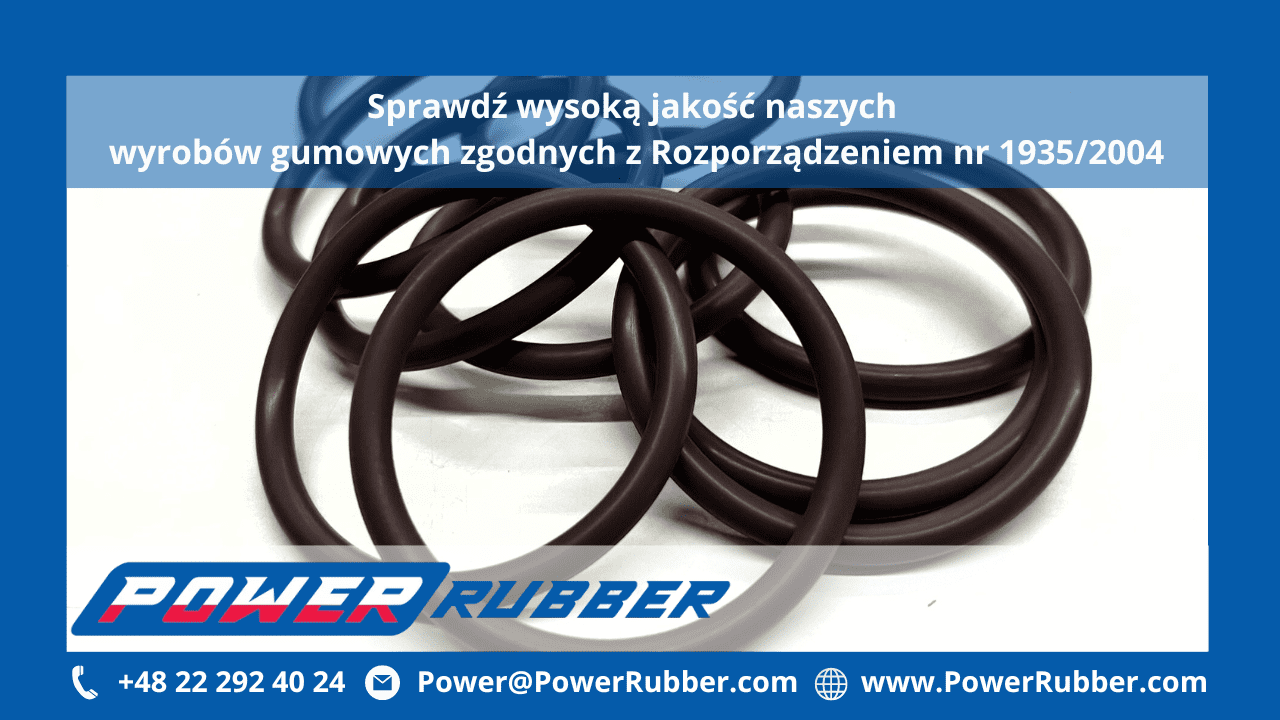
Rubber articles compliant with Regulation No 1935/2004
In the Power Rubber store we offer rubber articles compliant with Regulation EC 1935/2004 intended for contact with food. They have no negative impact on consumers' health or on the quality of food. They meet all legal requirements.
You can read more about food-grade rubber in our article.
If you would like more information about our rubber articles intended for contact with food, please contact us by phone: +48 22 292 40 24 or +48 505 16 03 03, by e-mail (Power|PowerRubber.com| style="background-color: rgb(255, 255, 255); color: rgb(0, 91, 171); border-bottom: 1px dotted rgb(0, 91, 171); text-align: justify;"|Power|PowerRubber.com) or through our contact form