Conductive and Dissipative Flooring – Understanding the Difference
At Power Rubber we can boast many years of experience in the production of top-class ESD floors. Our products play a key role in managing electrostatic discharges in critical environments. They are an ideal choice for specialized and technologically advanced rooms. They constitute an indispensable element of safety and efficiency in demanding areas.
What are conductive and dissipative floors and where should they be used? We answer these questions in detail in our article.
What is electrostatic discharge (ESD)?
Static electricity is generated by friction between two different materials. One becomes positively charged and the other negatively. Electrification occurs, among other things, during activities such as rubbing, pouring, shredding, and mechanical processes. All these phenomena can be observed both in everyday life and in production and technological processes.
Examples of actions that generate static charges include touching a door handle, walking on a floor, or even running a comb through hair. A positively charged material carries an electrostatic charge. Static charges remain on the surface of the body until we touch another person or object with some electrical conductivity, at which point the charge jumps to that person or object.
Large potential differences cause voltage discharges. Static electricity seeks the easiest path to ground.
A sudden transfer of electric current (or static electricity) is called electrostatic discharge (ESD). It is a short current impulse that appears between people or objects with a large difference in electrostatic potential. Although the discharge itself is brief, impulses of very high power occur. A static charge on a material can cause a spark discharge, which can lead to ignition of explosive atmospheres and a fire risk, electric shock to workers, as well as damage to electrical equipment.
Electrostatic charges in the workplace
Electrostatic discharges (ESD) can be generated by various sources present in the workplace. Clothing, footwear, furniture, equipment, and carpet are some of the items capable of generating static charges. Humidity and temperature play a fundamental role in ESD generation. Moisture helps dissipate charges. A dry working environment causes static charge to accumulate to a greater extent. For example, a worker walking on artificial carpet accumulates electrons that cling to the body until they are released.
Negative effects of ESD
Almost every industry faces problems related to electrostatic discharges. Electrostatic discharges bring negative effects both for people and equipment, especially sensitive electronic devices. This also applies to areas where flammable substances occur, such as fuels, solvents, gases, or flammable vapors.
The main hazards associated with electrostatic discharges include:
-
the risk of explosion and fire in potentially explosive zones - especially when a flammable substance is near a spark;
-
destruction of devices sensitive to discharges (so-called ESDS) - electrostatic damage causes, among other things, melting of metal at joints, damage to microprocessors, memory chips, and devices equipped with displays, leading to data loss, costly failures, and defective products;
-
electric shock to workers - electrostatic shock dangerous to workers' health and life;
How to prevent harmful effects of electrostatic discharges?
Static hazards can be minimized by taking appropriate safety measures to control the accumulation of static charges. One of the most important methods is purchasing a professional conductive or dissipative floor.
Antistatic ESD flooring
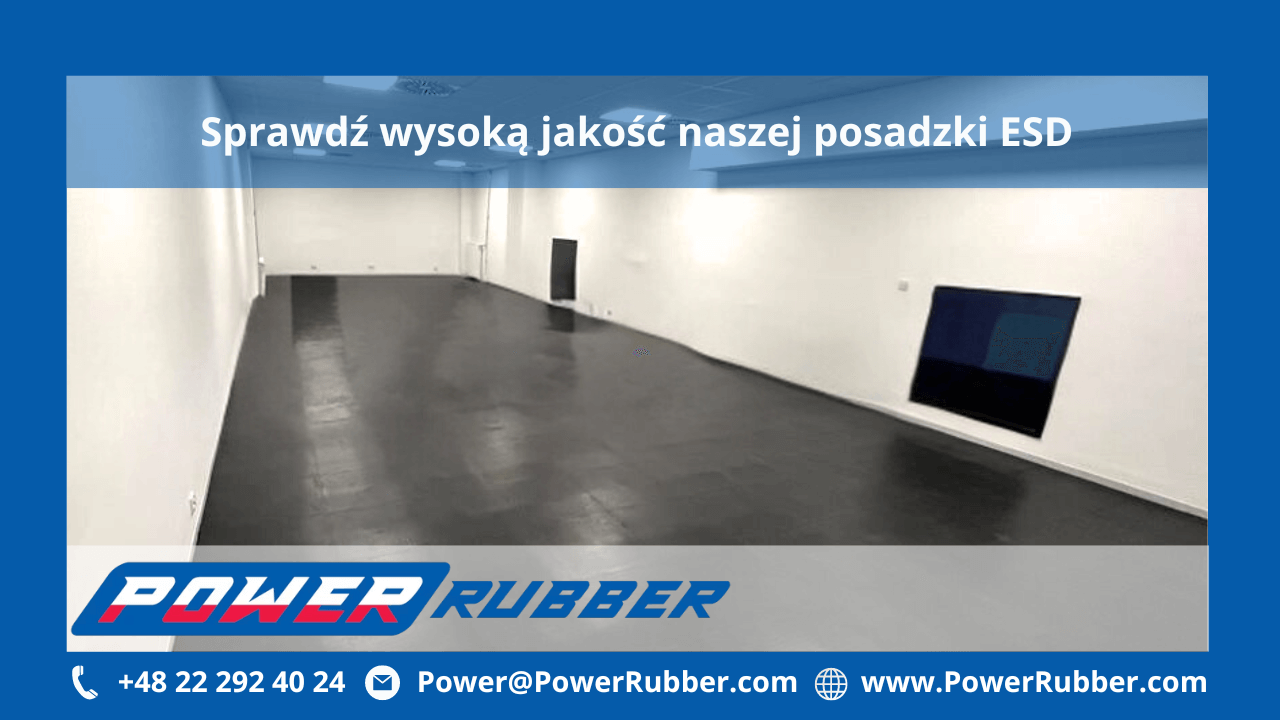
ESD floors (Electrostatic Discharge) are an essential and key element of safety when configuring a workplace. ESD floor coverings are extremely useful in industrial environments.
The floor is one of the largest surfaces with which people, equipment, and furniture regularly come into contact. ESD floors are classified based on their electrical resistance properties, which are measured and expressed in ohms (Ω).
Antistatic ESD flooring performs two key functions. The first is dissipating electrostatic discharges, and the second is reducing the accumulation of additional static electricity. They are divided into conductive floors (EC - Electrically Conductive) and dissipative floor coverings (SD - Static Dissipative).
Why use ESD floors?
ESD floors are essential for increasing safety in explosion-prone zones and in industrial areas that handle hazardous and flammable materials that can lead to explosions. They prevent excessive electrification (reduce the charging of objects), thereby protecting electronic devices and equipment sensitive to electrostatic discharges from damage or failure. ESD also serves to increase comfort and provides human safety in the workplace.
Antistatic and conductive floor coverings are abrasion resistant and easy to maintain. They are suitable for areas with high traffic intensity.
Antistatic floors - Applications
Thanks to high durability and the ability to withstand heavy traffic, our PowerFloor ESD PVC tiles are an ideal choice for various environments such as:
-
operating rooms
-
hospitals
-
medical offices
-
manufacturing plants
-
assembly lines
-
refineries
-
chemical plants
-
computer service centers
-
pharmaceutical plants
-
food industry
-
textile industry
-
electronic manufacturing plants
-
automotive workshops
-
plants producing electrotechnical components
-
server rooms
-
diagnostic laboratories
-
chemical warehouses
-
so-called "clean rooms"
-
call centers
-
air traffic control towers
-
individual workstations
-
environments where flammable materials occur
Dissipative floors
Dissipative floors are intended for use in rooms where electrostatic charges should be safely dissipated, such as laboratories, pharmaceutical plants, and electronic manufacturing plants. They have electrical resistance from 106 to 109 ohms.
Antistatic flooring is commonly used in environments where reducing the risk of damage to sensitive equipment and personnel injury is critical, such as data centers (server rooms, digital data distribution), hospitals, diagnostic laboratories, and rooms with controlled environmental parameters.
Conductive floors
Conductive floor coverings are used in areas where electrostatic charges must be completely eliminated. Conductive floors have electrical resistance less than 106 ohms. Due to their low resistance, they allow charges to flow through the floor material to the grounding system. Conductive floor coverings have antistatic properties. They minimize the risk of equipment damage and worker injury. This type of floor covering is commonly used in explosion-prone zones, such as petrochemical plants, where a spark from electrostatic discharge can ignite flammable vapors and cause a fire.
For floors to retain their conductive properties, professional installation is necessary, which requires particular care and proper charge drainage.
Which floor should I use: conductive or dissipative? - We explain
Movement of people and operating equipment generates an electric field. Mechanical sparks caused by impacts, friction, and abrasion can be particularly dangerous when the air contains flammable liquids or dust particles. Implementing appropriate ESD technology is crucial for safety.
How do conductive and dissipative floors differ?
The terms "conductive" and "dissipative" are technical terms used to describe how quickly or slowly an electric charge will flow across the surface or through the thickness of a material.
Conductive and dissipative properties are responsible for removing static electricity away from people or charged objects and safely directing the charge to the ground, i.e., grounding static charges.
What is electrical resistance?
To predict how effectively an ESD floor will ground charges, we measure its electrical resistance using a resistance meter. This is a device that measures in ohms the ability to oppose or reduce the flow of electric current.
Both conductive and dissipative floors conduct electric current (including static electricity) and provide a path to ground.
What is the difference?
If the resistance is low, the static charge will flow quickly across the floor, hence it is classified as a conductive material. A conductive ESD floor means any floor with resistance up to 1 million ohms (1,0 x 10E6) to ground.
If the resistance is higher, the static charge will have difficulty moving across the floor and will therefore flow more slowly. This control of electrostatic charges is classified as dissipative. A dissipative ESD floor means any floor with resistance above 1 million ohms (1,0 x 10E6) and below 1 billion ohms (1,0 x 10E9) to ground.
Which is best for me?
It is worth noting that if the floor is too conductive, charges can move across the floor surface, which carries the risk of electric shock to personnel who are in contact with the floor. Conversely, if the floor is too dissipative, the charge will accumulate faster than it is removed by the floor.
The ANSI standards organization requires that all ESD floors have resistance below 1 billion ohms. Meanwhile, NFPA and OSHA state that floors should have resistance greater than 25,000 ohms. There is a safety margin between these points.
The ideal floor range is between 1,0 x 10E5 and 1,0 x 10E8. Materials within this range meet current industry standards.
Important! The floor must be properly grounded and tested after installation to ensure it is not too conductive.
Where can I buy conductive and dissipative floors?
Various types of flooring offering antistatic properties are currently available on the market (e.g., PVC (PCW) floors, vinyl tiles, linoleum with a dissipative or conductive backing).
At Power Rubber we recommend investing in our high-performance ESD floors made of high-quality PVC in various colors and textures as well as ESD antistatic mats made of top-quality rubber. Both products have been specially designed to generate as little electrostatic charge as possible during walking or contact with other items.
Our conductive and dissipative floor coverings offer high performance and durability. They are also well suited for individual workstations.
Specialist ESD floors - available at Power Rubber
At Power Rubber we offer professional ESD floors that provide a surface free of dangerous electrostatic discharges, including mechanical sparking that can ignite an explosive atmosphere.
Safe conductive floors in explosion-prone environments
We provide a safe flooring solution with antistatic and conductive properties that performs exceptionally well in environments where there is a risk of creating an explosive atmosphere due to the mixing of hazardous substances in the form of dust, gas, or vapors with air.
Our products are characterized by high durability and resistance to mechanical damage and operational loads. The material from which they are made is resistant to degradation caused by contact with chemicals and to spark formation.
We invite you to cooperate!
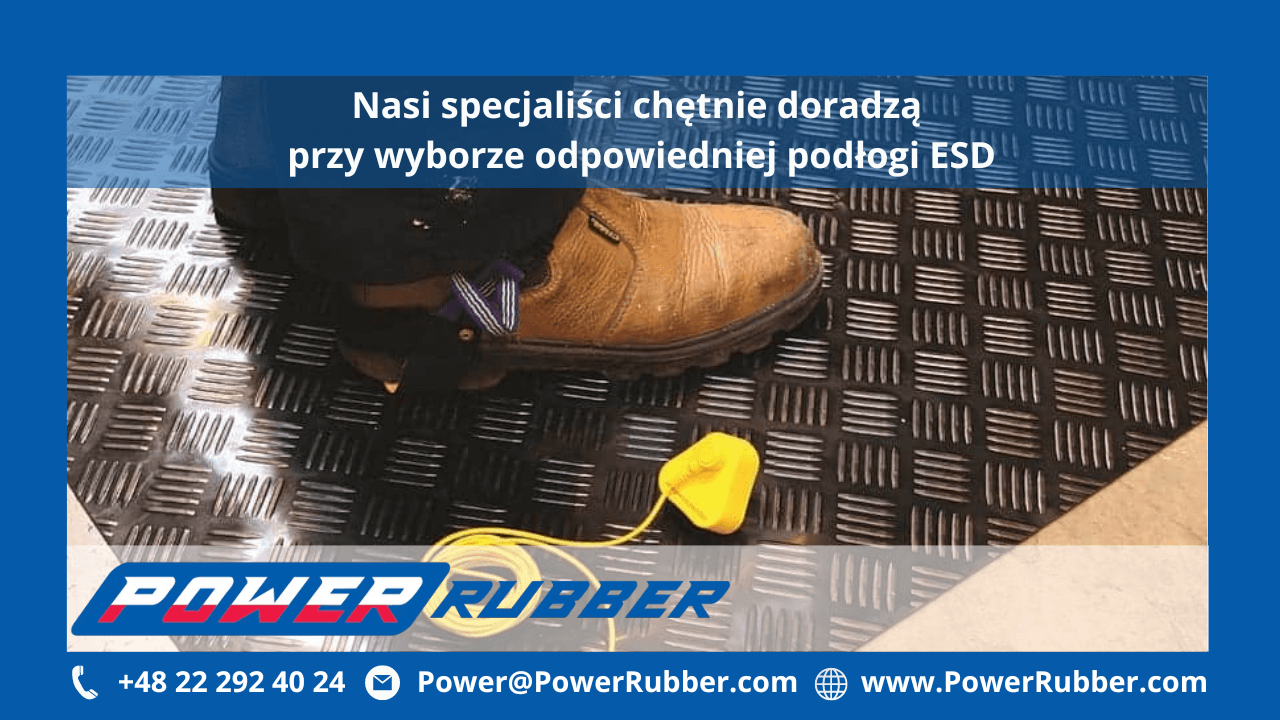
Our specialists will help choose the right ESD floor to effectively dissipate accumulated static electricity from staff and equipment, channel it through the floor, and safely ground it.
Contact us by phone at: +48 22 292 40 24 or +48 505 16 03 03, or by email (power|powerrubber.com| |Power|PowerRubber.com) or via our contact form